
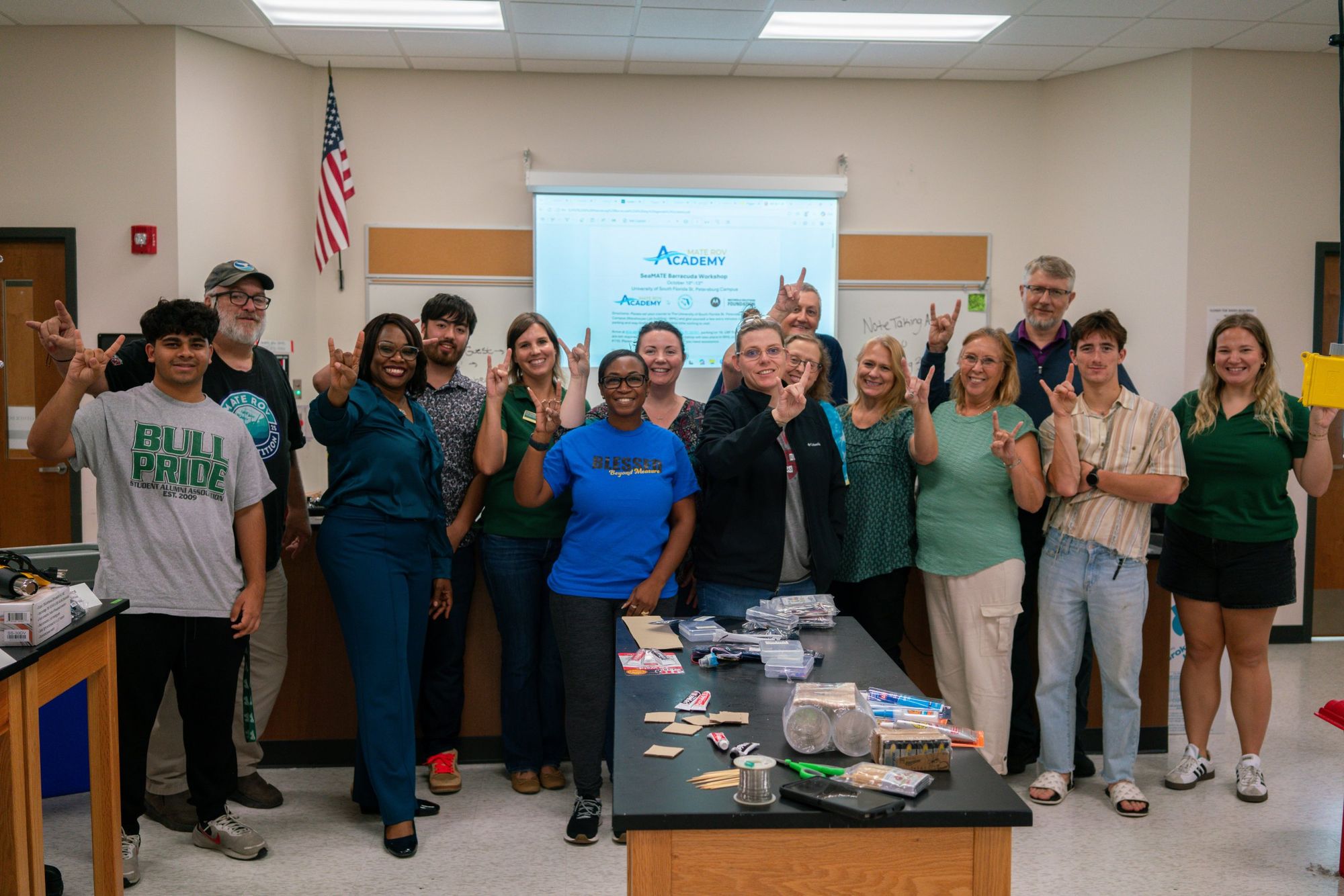
Over four days, educators took on the electronics, programming and troubleshooting behind the SeaMATE Barracuda ROV, gaining the skills to lead student teams into the MATE ROV Competition.
Educators from across the country spent four days at the University of South Florida (USF) St. Petersburg campus wiring, soldering and programming their own underwater robots, and left ready to guide their students through the same build.
The MATE ROV Barracuda Workshop, held Oct. 10–13, was the third underwater robotics professional development workshop hosted by USF’s Florida Institute of Oceanography (FIO) in partnership with the Marine Technology Society’s MATE (Marine Advanced Technology Education) ROV Competition program. Offered through MATE ROV Academy with support from the Motorola Solutions Foundation, the workshop brought together 9 educators from across four Florida counties, Oregon, and Georgia.
FIO’s first workshop, in January 2025, introduced teachers to the basics of building a remotely operated vehicle (ROV) over two days. This year’s program doubled the time and raised the technical bar. Participants built and programmed the Barracuda, a MATE ROV kit designed for teams moving from classroom models toward competition builds.
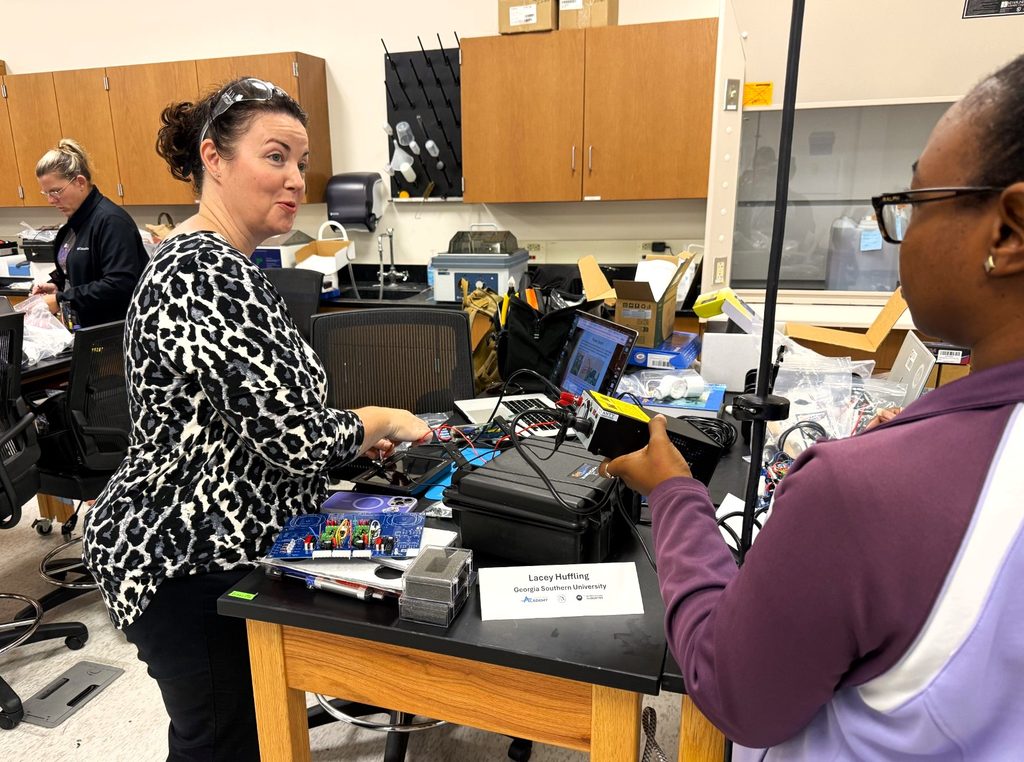
The first day opened with programming temperature and turbidity sensors, the same kinds of measurements ocean scientists use to monitor water conditions. Teachers then waterproofed a camera for underwater use and learned to solder and seal wires and connectors, building their ROV’s power wire and a practice circuit board.
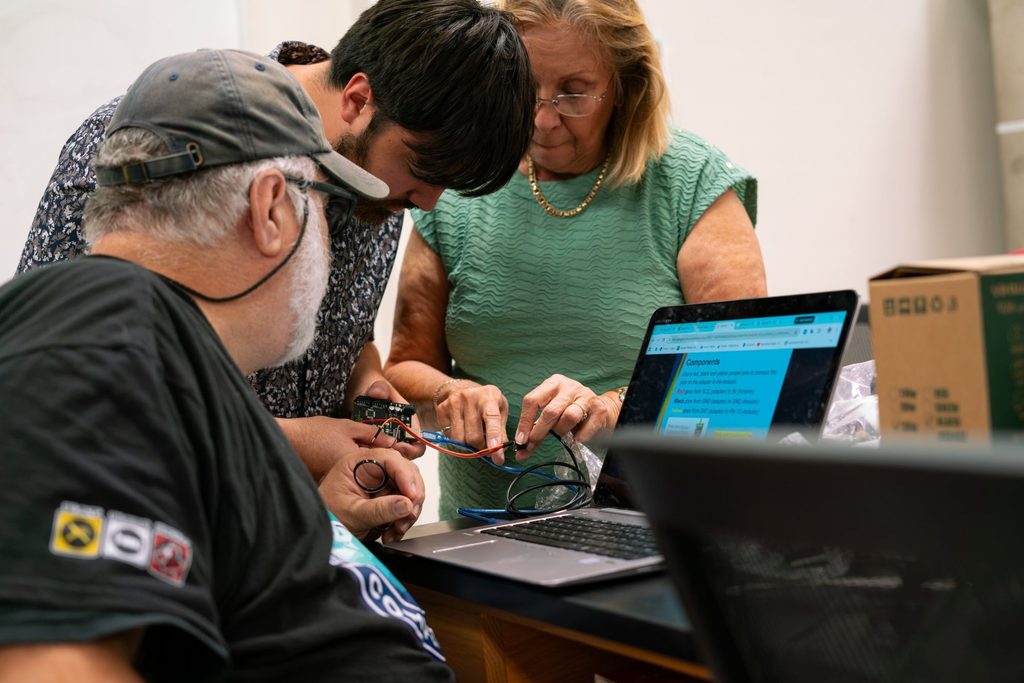
The next two days centered on the Barracuda’s analog control box, the system a pilot uses to drive the vehicle’s motors. Between sessions, participants worked through the circuit boards’ schematics and traced voltage through the ROV to learn how to diagnose electrical faults, a skill that comes in handy when a student’s build doesn’t work the first time. The sessions also covered tethers, cameras, monitors, propellers and buoyancy.
On the final day, teachers converted their systems from analog to digital control, soldering digital components and installing and testing the Barracuda control program. The workshop closed with discussions on frame design, stability, advanced control systems and how to bring student teams to the MATE ROV Competition’s Florida Regional in 2027.
Phoenix Robotics alumni, now USF students, assisted participants throughout the workshop alongside their former teacher and team leader, Eric Fernandez. The ROV team is based at Brooks DeBartolo Collegiate High School in Tampa.
Brooks DeBartolo earned an invitation to the MATE ROV World Championship at the 2025 and 2026 Florida Regional competitions hosted by FIO and USF.
Participants were also treated to a tour of R/V Western Flyer, where ROV Taurus lives, giving them a firsthand look at the platforms where ROV’s and marine technology are put to work.
“Three workshops in, we’re seeing what happens when teachers get real, hands-on engineering and marine technology experience. They go back to their classrooms and communities and build programs that put students on a path toward marine science and technology careers. That’s exactly the kind of pipeline FIO exists to support,” said Mike Kahle, director of FIO.
“This was a teacher workshop, but the goal was to provide these participants with the ability to take this ROV kit into their classroom and instruct their students in the lessons we went through in the workshop. The educators’ willingness to dive into a complex build when many/most of them had not built an ROV before stood out. The Barracuda is an advanced ROV, and the teachers were not daunted by the advanced lessons and persevered after making a mistake or facing adversity when something did not work correctly,” said Matt Gardner, MATE ROV Competition Technical Manager and workshop lead.
The workshop is part of a growing partnership between FIO and MATE to expand underwater robotics education on Florida’s west coast. In May 2025 and April 2026, FIO hosted the annual MATE ROV Florida Regional Competitions at USF St. Petersburg, where hundreds of middle and high school students designed and piloted underwater robots through real-world missions. Teams competed for a chance to advance to the MATE ROV World Championship.
“It’s important for students to learn (about ROV building) because obviously any time new technology comes out, it puts them at the front of our workforce. When we look at the marine environment, it’s hugely unexplored, and that’s a huge opportunity. I live in a coastal area, so the marine environment has to be important and combining those two just makes sense,” said Lacey Huffling, a professor in the College of Education at Georgia Southern University.
Huffling came to the workshop with two goals: launching an ROV team at a local K-12 school and preparing her pre-service teachers to start teams at the schools where they’ll begin their careers, carrying the training well beyond a single classroom.
With their builds in hand, participants now return to their classrooms to launch or grow ROV teams ahead of next year’s MATE ROV Florida Regional Competition at USF St. Petersburg campus, tentatively scheduled on April 24, 2027. Stay tuned for more!